Showing posts with label Courvoisier VSOP. Show all posts

Friday, 16 November 2012

Excuses for Drinking... Poker Night! part 1


Oh, hello there. I was just doing a bit of work. What’s that? Yes, you’re absolutely right; it is time for this week’s booze blog post. This week, it’s part one of a two part poker night double-header.
The poker night is synonymous with drinking, so for me, this was an excuse to finally crack open that bottle of Maker’s Mark that my brother-in-law had brought me over from Canada. Maker’s Mark is Kentucky bourbon (45% ABV), so it seemed appropriate to an extent to be drinking some American whisky while playing a game that is widely associated with America – Mississippi steamboats, cowboys and the like.

I also thought this would be a good opportunity to offload a few bottles that were almost finished, but that I frankly didn’t need anymore, and would relish the opportunity to replace. I’d had a small bottle of Brugal gold rum sitting on the top of the cupboard probably for around two years, and I just hadn’t found much use for it. Too good to use in cocktails, but not quite suitable for drinking on its own, it just sat there stagnating. That one had to go.

great bottle, disappointing brandy
Then there was the Courvoisier VSOP, that I’d bought with high hopes, only to be cruelly disappointed every time I tried it, and finally there was the remains of my Jose Cuervo Gold, that had frankly served me quite well. Well, now it’s gone, and I’m looking forward to an opportunity to try a different brand – preferably something 100% agave, but I’m sure there will be more about that in some future post.

We met at The Bull’s Head (David, Christian, Chris and me) for a quick pint (bottle of Newcastle Brown, in my case) before heading across the road to book a taxi to Dave’s. He’d already bought a deluxe poker set and picked me up some bottles of Double Maxim (4 for £6 – bargain) from his local Morrisons. I unloaded my booze, and prepared to make a start.

First on the agenda, a round of absinthe, prepared in the Bohemian style. That’s the one where you soak a teaspoon of sugar in the spirit before setting it alight and dropping it into a glass that already contains absinthe. Finally, douse the flames with a shot of water.

On this occasion I was far more successful than on any previous occasion I’d tried this. There were one or two minor outbreaks of fire, but I made sure to stir each glass thoroughly, thus ensuring that the sugar was fully dissolved into the drink. I necked mine, and it was actually quite nice.

That bottle of absinthe is almost entirely spent now. There may be enough for one more go though. I think I did quite well to get seven servings out of one 20cl bottle.

I wasn’t the only one to bring some interesting booze to the party. Midway through the first game David unveiled a mystery Chinese spirit that no one knew anything about. All the writing on the label was in Chinese, with the exception of the volume and ABV numbers – it was 52%, which was an exciting prospect. He said it had been a gift from one of his students. David is an academic in electrical engineering, so most of his students tend to be foreign. He often tells them to bring him a bottle of something the locals go for, and this was the result of one such transaction.

It was a completely clear liquid, and one that is clearly more suited to the far eastern palate than any of our western ones. I’ve tasted things like it before, but only things I’d picked up at random from the Chinese supermarket – specifically a can of bird’s nest soft drink, that I think was made with the spit of birds. I might have made that up at the time, having seen on a TV documentary once that a certain type of bird binds its nest together with spit. It has since become fact in my mind, so I’ll have to check it out next time I go.

Chinese spirit
The only picture that exists of this mystery spirit is provided by Dave. I’m afraid I didn’t think to take my camera, and the one on my phone doesn’t work. I’ve had a cursory search for “Chinese spirit” on Wikipedia, and it came up with this. There’s no real way of telling if this is the spirit in question, but it’s possible.

We did actually take the bottle with us to the Chinese takeaway that evening, to see if the people there could identify it. They couldn’t tell us what it was, but the lady suggested it may be worth around £200. I don’t think we can really trust that appraisal, given that she couldn’t identify it, but it was interesting nonetheless.

If the bottle was Baijiu, Wikipedia also reports that some brands go for as little as the price of a can of beer… so it could go either way.

We were already pretty smashed by the time we got to the Chinese, which made me having to play ‘guess which hand’ with the little girl there seem a bit weird, but you know, it was all fun.

After dinner (I literally just had salt and pepper chicken wings and salt and pepper spare ribs) it was back to the serious business of poker. We managed two games in all. I nearly won the first, but didn’t get anywhere near winning the second. I haven’t played many times in my life, and that’s how it always seems to go – nearly winning. We only played for a couple of pounds, so it was no great loss. In fact, I’m not even sure I paid my share because I didn’t have the right change.

After that it’s all a blur. I remember that we ended up walking part of the way back to town because we thought 45 minutes was too long to wait for a taxi. I don’t remember how we actually got to town, but I do know that Chris and I shared a taxi from town.

I also think I woke up in the night, feeling incredibly nauseous, but even of that I’m not certain. I woke up the next morning feeling like I weighed a ton. It’s not the worst hangover I’ve ever had, and in fact I was fairly compus mentus considering how much I’d had to drink. I was able to perform the day’s cleaning duties fairly well, but didn’t attempt much else.

Since that night, David has told me he’s come into possession of another bottle of the Chinese mystery spirit. He made the mistake of thanking his student, and saying it was nice. Sometimes it doesn’t pay to be polite.

Right! Well, I'm taking Mrs Cake out on a date tonight. Just dinner and drinks. We'll see where that leads (wink,wink) - probably to an argument and awkward silence! No. It'll be fun. We're looking forward to it. Good luck with whatever you have planned for the weekend, and see you next week!

Friday, 26 October 2012

What is it with whisky reviews? Part 2: Colour Classification


In a previous post I got all carried away with the phenomenon of whisky reviews; and by that I mean the way people dissect the flavour and scent of whisky and separate it into constituent parts – vanilla, cloves, red berries etc. If you didn’t see that post, you can have a shuffty here (it was only last week), or if you can’t be bothered with that, here’s a particularly evocative example from the Caol Ila website

CAOL ILA 18 YEAR OLD
Age introduces a golden colour and complexity to this mellow, amber Caol Ila. It starts smoky-sweet on the nose then drinks smoothly, showing a sweet yet sour character. The long-lived finish evokes a distant, smouldering beach bonfire.
NOSE
Smoky bonfires, then soapy water and wet wool, with a smouldering beach bonfire in the distance. Hints of mineral oil, then wax. Develops scents of burnt pork sausages.
That one’s not actually that bad; it keeps the flavours listed to a minimum, and instead goes for more of a description, but still; you can see the sort of thing I’m getting at.

When I was writing the post, I was also ensconced in a book that you may have seen me make mention of a good few times already: Ian Buxton’s 101 Whiskies to Try Before You Die. I remarked on how his reviews classify the colour of the whisky as well as the scents and flavours. So I thought it would be nice to follow up What is it with whisky reviews? by delving a little deeper into that.

colour charts
I am well aware, as I’m sure you are, that the colour of whisky can vary quite widely (within certain parameters – I mean, it’s never going to be green, is it?). What confuses me is how someone could look at one whisky, and say ‘that’s golden amber’, then look at another one and say, ‘that’s amber gold’.
 
Sure, the colour of some whiskies differ greatly from others, but it is also true that some are quite similarly coloured. ‘How does he do it?’ I asked myself. “Does he have a Dulux colour chart or what?

And thusly was an idea born. The next time I had a reason to go to B&Q (purchasing a blueberry bush for my sister’s housewarming present), I stopped by the paint aisle and collected all the colour cards that might represent the colour of whisky. These aren’t standard Dulux colours that you can buy in tins, but the ones you can have the staff mix up for you, and there were quite a serious number that might correspond to the colour of whisky. I ended up collecting 17 cards. Some were classed as yellows and some as reds. Oddly, the ones that were classed as gold weren’t anywhere near the colour of whisky. I say oddly because Buxton’s book has a good number of the whiskies classed as some form of gold or other. I stashed the cards in the pouch of my hoody, and took them home where they now sit in my booze cupboard awaiting any occasion I pour a glass of whisky.

I’ve never really found those B&Q colour swatches useful. Just as I find it impossible to taste a drink and say, “this tastes of cloves, fresh mown grass and mussels”, I have an inability to look at a 6.1 x 2.8cm block of colour and apply it mentally to a whole room. In addition to that, I’d contend that the paint looks a different colour on your walls than it does on the sample.

Nevertheless, I thought it would be fun to apply an actual guide to help with classification. If I can also determine what the Dulux classification is for some whiskies that appear in the book; that will be great – of course it will ultimately be pointless, but nevertheless great. And maybe one day I can paint a room the same colour as one of my favourite whiskies, and maybe that will be all relaxing, and when I drink a glass of that whisky, I might feel like I’m swimming in it.

Actually, a few years ago, [I think it was] B&Q [who] ran an advertising campaign, the gist of which was that if you found a colour you wanted, you could take a sample of it, and they would mix up a paint of that colour for you. In one such advert, a woman liked the colour of a man’s hoody, and cut a chunk off of it with a pair of scissors. By that token, how cool would it be to take a bottle of whisky into B&Q, pour a glass, and say, “I want a paint in this colour”?

Now, in case you don’t already know, the recommended practice for appraising colour is to pour a glass, and then gaze at it against a white background. Until I read the 101 whiskies book, I hadn’t realised the point was that you could then try to decide what colour it was. I thought it was just so you could go, “that looks nice”. It always looks nice.

My first experiment was with the Dewar’s 12 Years Old, double aged that I picked up in Ibiza Airport’s Duty Free shop. I saw the other week that you can get 70cl in Sainsburys for the same price that I paid for a litre there. That seems to be how Duty Free works, in the main; 30cl extra free. It’s just a shame that sometimes you don’t want the extra. I’ll be a little more careful in Duty Free next time.

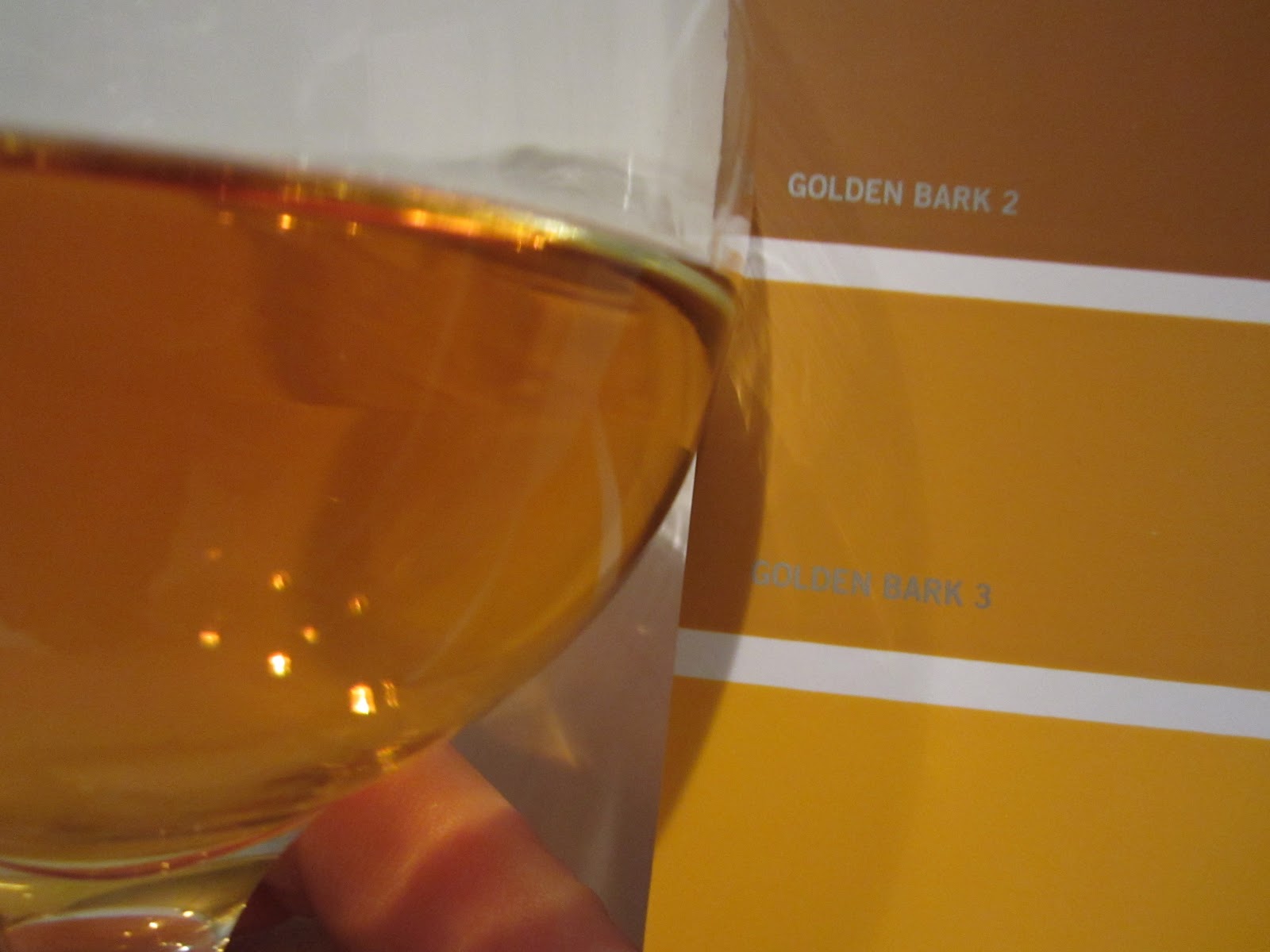
I poured a generous glass, held it up to my kitchen cupboard and cycled through my various colour cards, attempting to see which one matched most closely.

Dewar's 12 yo, golden bark 3
I was initially a little sceptical that I would find any exact match, but I think I did fairly well. I may not be quite on the money, but I think its close enough. Take a look at the picture, and see for yourself. So Dewar’s 12 Years Old, Double Aged is Golden Bark 3. I can’t compare this one to the Dewar’s in the book, because I got the wrong Dewar’s. The one in the book is “Special Reserve”. Oh well.

While I’m on it, I may as well give you a brief first impression of the Double Aged Dewar’s; I was impressed at first. You know that I don’t know how to describe flavours, but my first reaction was, “oh yes, that’s a classy taste”, but then the familiar blended scotch taste took over (must be the grain), and each succeeding sip was an attempt to repeat the experience of the first sip – mostly unsuccessfully. It seems I had become desensitised to it already. If that’s the way it stays, it looks like being a frustrating whisky. Time will tell. And then it will probably tell all over again. Litre frickin’ bottle, I don’t know.
Grant's, sulphur springs 3


I moved on, and was able to try a swatch test with my bottle of Grants’ just before I finished it. It’s a good deal lighter in colour than the Dewar’s, and came out as Sulphur Springs 3, as you can see. At that point I decided I’d try a few more before publishing my findings. Here they are in order of experiment:


Courvoisier VSOP

I couldn’t find a match for this one, but that’s ok as I didn’t get brandy coloured colour swatches. I thought I might find a match though, as in the bottle it looks a lot like whisky. In the glass it actually has a much more red tint than the whiskies I’ve tried so far.

Maker’s Mark

Maker's Mark - no match
No match this time, either. Ian Buxton describes it as amber, but I’m afraid I couldn’t get anything even near to it from Dulux. Interestingly, the St Remy XO brandy that Brenda brought me back from Paris is described on the St Remy website as amber in colour, and Caol Ila is described as amber in the example at the beginning of this post, yet there is a world of difference between these three.

The Black Grouse

This time I had another success, and with another blended scotch. The Black Grouse came out as Earth Glaze 3. It’s always ‘3’ it seems, so far. I don’t know what an earth glaze is – I would have expected that to be more of a brown, but there you go.

Black Grouse - Earth Glaze 3
Finally, the testing has proved to be quite fun, so I’ll keep it up for as long as it continues to be so. I’m not sure yet whether that will mean another specific post, or whether I’ll just throw a result into any article where I happen to mention a new whisky. So we’ll see.

Mrs Cake thinks I’m doing this just to facilitate my growing obsession with whisky, but I continue to protest that I’m just being silly, and that it is entirely for fun. Which it is really. Anyway, it’s her fault: she bought me the 101 Whiskies book in the first place.

That's it from me for this week, then. I expect I'll be back next Friday with something else. Have a great weekend, and here's hoping for some fun alcohol fueled adventures to write about in the near future.

Friday, 3 August 2012

Budget Brands: Grappa from Tesco


The cost of the four holidays I had last year is catching up with me, and I have some big expenses coming up – home insurance and the like – so the austerity measures are hitting pretty hard around here. Not the government’s austerity measures; my own. There’ll be no spending with reckless abandon for a while – except for the stag do, the second stag do and the honeymoon, where I’m looking forward to hitting the Duty Free - but facilitating those is a large part of what these measures are aimed at, so things aren’t all bad.

Still, a man needs some short term things to look forward to, so I went to work last week with £20 in my wallet, and I told myself, if I had enough left at the end of the week out of that £20, I would allow myself to buy that cheap bottle of grappa that they have at Tesco. So I needed to have £13 left. If you budget for 5 a side at £6.20, that would leave 80p. So there was to be no chocolate and crisps whenever I got hungry, no bacon and sausage barm first thing on Friday morning, and definitely no takeaway pizza for lunch. It was going to be hard, but these travails make us stronger.

Enough about my financial strait jacket, what about the grappa? Well, yes, of course I made sure that I had £13 left at the end of the week. The carrot and stick approach worked very well. How good though, could a bottle of grappa at £13 possibly be? Obviously I wasn’t expecting it to live up to the standard set by the Domenis Storica that I bought in Venice last year, but retailing at £45-50 in the UK, that one is a little beyond my every day means if I want a nice glass of an evening. If Tesco’s product is even half as good it would be a bargain and a potential new favourite.

The budget brand in this case is Grappa Julia Superiore. It’s the only grappa available in Tesco, and I haven’t seen any other grappas in other supermarkets, so I assumed it would be the equivalent of Bells whisky. Nevertheless, my burgeoning interest in grappa is such that I had to try it.

It has an ABV of 38%, so it is budget standard in that area (the Domenis Storica was an impressive 50%), but in the bottle it looks the part - it’s an interesting shape, and it appears to be made in Italy (as opposed to the Italian part of Switzerland or San Marino, which are the only other places that grappa can come from). Nowhere does it say, “bottled for Tesco”, or anything discouraging like that, though there are descriptions on the back in French, English and German – to me that’s not a great sign, but cool yer boots…

It’s also a full size 70cl, whereas the Storica was a conservative 50cl. A bit of geeky maths tells us you’re paying 18.6p per centilitre for the Julia and a massive 90p per centilitre for the Storica. A bit more geeky maths tells us that the equivalent quantity of Storica would cost £63 - drop for drop, that’s 5 times more than the Julia.

The cap is screw top, so there’s no satisfying squeak-pop on opening, but it has the right smell, and it tastes right. It doesn’t have the lovely sweetness of the Storica, but its (slight) bitterness isn’t overpowering or lasting. It makes a very good first drink of the evening, and I have to say, for £13 I’m satisfied. If I’ll ever buy this brand again, only time will tell – I’m not sure what my grappa needs are yet, but if you do get a craving and your funds are limited, or you’re bored of brandy like the checkout assistant at Tesco said he was when I bought this, it would be worth your while to give this a try.

I was explaining to the assistant that grappa is like brandy, but made differently, and come to think of it, if we widen our net of comparison to compare this grappa to brands of brandy, say the Courvoisier VSOP that retails around £30, I think I much prefer the grappa – it’s half the price, and out of all the sipping bottles I have at the moment, it’s proving to be the every day go-to. No, it’s not as special as the Caol Ila cask strength whisky, but it’s precisely because that’s special that I don’t go to it every day.


The Storica was special also, and all the more precious because of its limited quantity, so while Julia doesn’t quite reach the heights that that one scaled, it’s affordable to the wallet and acceptable to the palate. What more can you ask for?