Showing posts with label The Black Grouse. Show all posts

Saturday, 9 November 2013

Jim Murray's Whisky Bible 2013 Review

Christmas before last, the [then] soon to be Mrs Cake bought me my first Whisky guide; 101 Whiskies to Try Before You Die, which I have referenced on this blog previously, and even dissected in great detail. You may remember (or be interested to know, if you don’t want to read any of my previous pieces) that, while I found the contents of that book fascinating, I was finding its recommendations to be disappointing. It left me wondering where to turn for advice when it came to buying a new bottle (this was long before getting involved in the local Manchester Whisky Club), so when the missus asked what I would like for Christmas last year, I said a new whisky guide. She duly obliged, and what she came up with was Jim Murray’s Whisky Bible 2013.

I’ve dipped into this many times already, and wow, he sure has a lot to say. And boy, does he like whisky. I mean, I like whisky, but leafing through these pages that contain reviews (some brief, some less so) of over 4500 whiskies, I started to think that maybe I don’t like whisky all that much after all. Why? Notwithstanding that I would be bored of anything if I’d had to try 4500 varieties of it; the first thing is Jim’s scoring system.

He scores each whisky out of 25 for nose, taste, finish and balance, and combines these scores to give a total out of 100. I’ve been wondering why he scores them out of 25, and can only conclude that this is for the express purpose of combining to make a score out of 100 and when you think about it, when you have over 4000 contenders, awarding up to 5 stars just doesn’t seem adequate. Similarly, scoring each component out of 5 to make a total score out of 20 wouldn’t do; more separation is necessary.

Where this logic falls apart though (apart from the idea that four different components should be weighted equally), is that from what I’ve read so far (that’s all the section on single malt scotch, blended scotch, Irish whisky and selected highlights of the rest), the lowest score any individual whisky achieved was in the mid 50s – and that was an anomaly, most of the others are in the 80s and 90s. The next lowest is something like 68*. 

Now, 68% isn’t going to get you an A in your GCSEs, but it will get you a good second class degree and it isn’t that bad – in fact, you’d be disappointed you hadn’t gotten a first if you’d been averaging 68. It works out to an average of 17 out of 25 for each component, and I think 17 out of 25 is pretty good. If you scored that in each round of a pub quiz (probably the only other thing I can think of that could possibly be scored out of 25), you would probably win. I don’t see then, how there can’t be a whisky that’s so bad it only scores 32. Even Aldi’s Higland Earl, about which Murray says, 'I would have scored this higher if it had been labelled grain whisky; the malt is silent' scores 77.

Murray has written an editorial at the beginning, in which he bemoans the practice of using sherry casks that have been sterilised with sulphur candles. Apparently this has been going on for 20 years, and for some reason few people in the distilling industry are aware that it is ruining whole generations of scotch. Murray is well aware of it though. He can smell and taste the sulphur, and he says that there are a number of whiskies, aged in sherry casks, that have been ruined by this practice – ruined. Yet he won’t score any of them below 50 out of 100.

I’m not saying he’s making this shit about sulphur up. I believe him (though I’m yet to experience it myself). I just think maybe his scoring should be more reflective of that. Is it a bad whisky? Yes. So shouldn’t something that is actually bad be scored say, less than 50%?

Some time ago I received a particular bottle as a present which shall remain a secret so as to protect the feelings of the generous donor. I tried my very best to like it, but seriously, it was the worst whisky I have ever tasted. It tasted metallic, and that metallic taste just dominated everything.

I was keen to see what Jim Murray thought when I received his book, so it was one of the first things I looked up. I could see there are actually a lot of bottlings by this distillery, and many score in the high 80s and into the 90s.

Pretty good, but I can see that the one I had tried scored in the middle 80s. Surely that couldn’t be right? That’s actually better than a number of (to my mind) finer whiskies that I’ve enjoyed very much – like the Glenfarclas 10.

What’s more, it’s one of the Sherry Cask editions that received the lowest overall score of 50 something. So mine was supposed to be nice. I’ve checked, and sulphur isn’t metallic, so that’s probably not what I was tasting. So what does this mean? Presumably it means this distillery’s output  isn’t to my personal taste, and perhaps I should follow my original intention to avoid purchasing any further bottlings, at least until I’ve tried one that I like.

Murray goes on to say that many people can’t taste or smell sulphur anyway… perhaps I’m one of them? Though I’m sure I’ve smelled sulphur at some point in my life previously – it stinks doesn’t it? Like rotten eggs?

I suppose I still have to find out whether I’m susceptible to having my whisky ruined by sulphur. I don’t think I’ve tried many that have been aged in sherry casks, and I haven’t been able to detect it in the few I have tried. Some distilleries don’t use casks contaminated in this way anyway, but it seems the only way of knowing which ones do is by reading Jim’s book, so while it’s tempting to avoid any sherry cask whiskies, those have been the ones I’ve been enjoying in random samplings so… I don’t know what to do. I’m certainly reluctant to spend more than £40 on a sherried scotch anyway…

So as I said, Jim seems to love his whisky far more than I do. If I go to a tasting and try 6 different whiskies, instead of coming away with an idea of what I might buy next time, I come away with a list of 6 whiskies I’m not going to spend my hard-earned on. He’s a real enthusiast, with some refreshing viewpoints, occasionally witty, and he doesn’t come across as a whisky snob. What gives me that idea? He loves blends. In fact, he claims that he judges blends by stricter standards than single malts, since he thinks that in blending you should be able to achieve so much more.

I’m not sure I’m inclined to agree, since most blends include a hefty proportion of grain whisky (50 or 60%), that from what I can tell has a harsh taste that has somewhat tended to stand out  - or at least lope about conspicuously in the background - in many of the blends I’ve tried (I haven’t tried any particularly expensive ones as yet).

Jim should know better than me though, and that doesn’t bother him. He’s clearly a fan of the grain whisky too (he’s included a section for reviewing grain whiskies, and they also score well), but he’s especially a fan of the blend. Bells, Teachers, Aldi’s Highland Black, The Black Grouse… they all score really well – especially the Black Grouse, which manages a stunning 94.5. I certainly wasn’t that impressed by it, but clearly I must be an idiot

He reviews just about everything, and that’s part of what makes this book so accessible. If you’re something of a newcomer to whisky, and you pick up 101 Whiskies to Try Before You Die, you might find you’ve tried two or three, so you don’t have much of a reference point for the rest of the book, but you do have a lot of catching up to do. Because Jim Murray reviews everything (a further 1350 new whiskies were tried for this edition alone – did he try four a day for a year? And if so, doesn’t that cast some doubt on the reliability of the review?), there’s already a whole slew of things in there that you’re familiar with, and you can while away a good deal of your Christmas holiday downtime just flicking through it.

There is no price guide however, so you can’t really use it to plan your next purchase in advance, unless you happen to be accessing the internet at the same time. That also means that all whiskies are judged to the same standards, which is good in one way, but less so when you want to consider value because, let’s face it; it makes a difference. No, this whisky isn’t as good as that one, but this one was £13 while that one costs £100. I’m yet to determine whether any whisky can justify an astronomical price tag when I could buy one of my current favourites for £35 to £45.

You might find, like I often did, that Jim doesn’t rate your favourite whiskies as highly as you do, but you know, that’s fine. It’s actually refreshing how he’ll review something like Lidl’s own brand scotch, and score it really well. It gives you the confidence to buy that staggeringly cheap blend, and actually think that it might be ok because someone of his standing is willing to try it, review it with the same attention that he devotes to premium brands, and score it well.

But this is also the problem, though perhaps only for me. I don’t fall in love with every whisky I try. Perhaps I’m setting my standards too high, but if not disappointed, I’m often non-plussed when I try a new whisky, and all I’m doing is searching for that special and sadly rare liquor that I’m going to savour to the very last drop and perhaps even pine for when it’s gone – or want to buy again instead of trying something entirely new. That’s not too much to ask, is it?

Sometimes I feel I’m not even enjoying my glass of scotch, so I certainly wouldn’t be scoring nearly everything in excess of 80 out of 100 (that’s 4 out of 5, which if we were talking books, films or music would signify an excellent score – assuming you reserve top marks for the very select few, as I would).

Don’t think I’m having a go here, because this book is fascinating, but rather than answering all the questions, it leaves me with more.

Get this; it’s supposed to be a whisky bible, so you’d think therefore, that it will be a reference text you can rely on. But no. The impression I get from reading it is that Jim’s opinion of whisky can vary greatly over time – even on something as standard as a bottle of The Famous Grouse. He might say something like, “this has improved greatly since the last time I tried it…”

Now I know the quality of whisky can vary to some extent from one bottling to another, but you’d expect a blend to be pretty consistent. My enjoyment of a whisky can vary from one tasting to the next –from the same bottle. So Jim is clearly well able to rely on his tasting faculties, and treat his conclusions as absolute.

If I tried a glass of the Famous Grouse on one occasion and thought it average, but tried another one another time, and liked it, I’d assume it was something to do with myself or the specific circumstances. Jim just says, “this bottle is better than that one I had last time” – presumably because the method described in his tasting guide is so infallible.

When Jim says in his review of Johnnie Walker Red though, that he had one at an airport and he was overcome by peat, and that it was the earthiest he had tasted in decades… are we to assume he followed all the preliminary steps of his tasting guide, or was his impression open to the same chaos elements that are present when you don’t drink a strong coffee first, find a room with no distractions, haven't recently washed your hands, or have a glencairn glass (does he request one even in airports?) to hand?

Regardless of instances like this, how can you rely on Jim’s recommendation when you might be buying a bottle from the batch he didn’t like? How are you supposed to know?

Another problem is that sometimes it’s difficult to know whether you’ve got a particular bottle. Case in point; Bladnoch 10 yr old. He scores it brilliantly, which pleased me because I’d acquired a quarter of a bottle. On closer inspection though, he specifies that it’s a ‘Flora and Fauna’ bottling, which my bottle didn’t give any indication of being. Then I noticed that he had specified that his was bottled at 43%, while my bottle stated 46%, so clearly they weren’t the same. How different are they? Well, I don’t know, but I suppose it doesn’t matter too much because the bottle I’ve got is very classy; delicate and sweet (just how I like my women).

A look at The Whisky Exchange provided an answer – my bottle retails at around £35, while the ‘Flora and Fauna’ bottling, which is the last Diageo bottling is listed (at time of writing) at £75. It would be nice to know without having to do further research though – I’m used to books giving all the information, not just part of it. I’d also like to know, given that the Flora and Fauna bottling that Murray is reviewing gets 94 out of 100, what mine would score – but I’m not going to buy the 2014 guide to find out (I’ll just have a quick look in Waterstones…).

Examples like this are endemic throughout the book. Is this the bottle I’ve got? Is this the bottle I’m considering buying at my local whisky specialist? Is this the particular bottling I picked up at that distillery? He doesn’t provide quite enough information to be able to make you sure (see also Suntory Hakushu 12, later).

Again, I’m not denying Jim’s credentials. He certainly drops enough knowledge and has a lot to say. I don’t think you can fake that, it just means I can’t necessarily rely on the information in the book from one year to the next. What if next year, I buy a bottle of something based on Jim’s recommendation, but it turns out to be terrible, only I didn’t know because Jim’s review wasn’t current enough, or I got an older bottling, or perhaps he changed his opinion in 2014’s guide?

So as I say, extremely interesting, but perhaps a bible to be treated with the same reverence that a modern, non-church-going Christian would treat their Bible. That is, Adam and Eve? I don’t think so. Don’t be getting all Westboro Baptists’ Church about this.

Jim is drawing on 30 years of tasting experience, and he does point out that his scores are very personal, and based upon that. He obviously has a deep familiarity with many of the distilleries and brands that he is reviewing, and bases his score around what he has come to expect from any single producer – so there is ultimately little chance that you would agree with all that much.

To be fair, it doesn’t make the book any less useful or interesting, so I’m just going to have to take it for what it is, and get on with it.

Now, I still haven’t quite seen the point in adding water to whisky, as I know a lot of whisky experts tell you to do – except in the case of cask strength expressions, of course. I understand, and from experimentation with Caol Ila’s cask strengthvariety, agree that the strength of the alcohol is likely to overpower the subtle flavours and aromas in the whisky. One thing that strikes me as strange then about Jim’s book is that he asserts that he tests every whisky, as it is. He doesn’t add ice or water, and the rationale is that there can be no discrepancy between what he is tasting and what you are. That’s great until you think that he must be reviewing the cask strength whiskies under those same guidelines. So how can he provide a sound review of a cask strength whisky – some of which are more than 60% ABV, and intended for the addition of water – when most of its subtleties and nuances are being masked by strong alcohol? Well, presumably he can’t.

He could add half a measure of water to a double measure of cask strength whisky though, and specify that he did. But no. Surely, if his reviews are supposed to hold water (so to speak), he needs to try several stages of dilution and then comment on the overall quality, so that it doesn’t matter whether you add the same amount of water as he does. It’s just one of those things that you’d think a whisky aficionado would have to address – what’s the point in me reviewing this if I’m not allowing it to develop fully?

I suspect that Jim is experienced enough to be able to provide a full review of a whisky from one taste, whereas I would have to drink the whole bottle before giving a definitive (and admittedly less detailed) review.

I suppose the ultimate indicator of how good a guidebook is, is in the results of using it. Did you agree with its recommendations? I have had chance now to dip into it and use it for research when I know what kind of thing I’m looking for, and just require something to give me a definite push one way or another, and as I said, because it’s scope is so extensive, I’ve already formed opinions on some of its subjects, so let’s break this down to specifics. Here’s some comments on some of the whiskies both Jim and I have tried:

Laphroaig 10/Quarter Cask
Laphroaig 10 was one of the first whiskies I ever tried, and I immediately fell in love with it, but the Quarter Cask I actually felt was lacking in everything that made the 10 so great. Jim scores the 10 year old 90 (while noting that it is a favourite of Prince Charles), and the Quarter Cask 96.

Caol Ila 12/18
12 is one of my absolute favourites – sweet, smoky and luxurious – and as such provides a benchmark for the opinions of anyone that reviews whisky. What I’m essentially saying is if you don’t rate the Caol Ila 12, your opinion means nothing to me.  The 18 year old on the other hand was quite a disappointment, with a bitter finish that belied it’s extravagant price tag. That currently stands as the most expensive bottle I ever bought.


In Murray’s book, the 12 scores what is in my opinion, a modest 89 while the 18 scores only 80 – with the stipulation that there is too much oil. 80 seems quite fair, and consistent with Jim’s scoring system.

Black Grouse
This one doesn’t just come recommended by Jim; it’s also in the 101 Whiskies… guide. I just don’t get what all the fuss is about. Jim calls it “a real treasure” and scores it a 94. Frankly that’s shocking. If you read that, and then see you can get it for £18, you’re going to buy it, aren’t you? Sorry, but there is no way this is better than the Laphroaig  10 and the Caol Ila 12. No way – even when you take the price into account.

Talisker 10
Another that is almost universally recommended. I think it’s decent but I’m not overly enthused. Jim rates it almost as highly as the Black Grouse, with a 93. He also tastes some Cumberland sausage in there. For the record, I think it is way better than the Black Grouse, but would still score it below a 93… were I able to put numerical values on these things.

Glenmorangie Original
I was surprised to find I enjoyed this very much. Great value. Jim calls it one of the greats, and scores it a 94. I’m not sure it’s that good, but still…

Cutty Sark
I think Jim and I are actually in synch here. Distinctly average, I felt. Not bad for the price I paid, I suppose, but not worth the price you pay in the UK. Jim says it has a ‘nipping furriness’, which I’m not going to disagree with despite not having any way of truly knowing what he means, and gives it 78.

Glenfarclas 10
I enjoyed this very much, but here it scores only 80, and is described as “sweaty” with an odd finish.

Suntory Hakushu 12
I bought this based largely on Jim’s recommendation, though that recommendation was supported by a number of online sources. I did enjoy it, but didn’t quite feel it lived up to the hype. There are three Hakushu 12s listed in Jim’s book. The only way I could identify which one might be mine was by the ABV of 43%. That is actually the best of the three, scoring 95.5. It is apparently one of the most complex and clever 12 year olds in the world, though I felt it had a slight bitterness in the finish that detracted from its oily mouthfeel and sweet entry.

DYC 8
One I actually sought out, based on Jim’s recommendation. I can’t understand what he saw in it. 90 points, ‘clean and cleverly constructed’. I would score it much lower and change ‘clean and cleverly constructed’ to ‘aniseedy and weird’. I rank it as the worst blend I’ve ever owned and the second worst overall whisky.

Ardbeg 10
This is an immense malt and I can only agree with Jim’s glowing opinion of it. 97 points he gives it. I have no problem with that other than that there are only 3 more points a whisky can occupy to be better than it. So it can only possibly get 3 better than Ardbeg 10.

Ballantine’s Finest
A little research I did recently for an upcoming post featuring Balantine’s Finest found that customer reviews on whisky retail sites held it in high regard while bloggers and more formal critics… didn’t. For the record, I have been enjoying the Finest very much, and would place it at 3rd in my all time blended scotch rankings. Jim calls it the work of a blender at the top of its game and scores it 96. I don’t think it’s quite that good – again, when compared with lower scores for Laphroaig and Caol Ila, and especially when he claims to score blends more harshly than single malts.

Conclusion
So what can you take away from this? Certainly that you can’t treat the guide as an all-knowing oracle that you could rely on to find you a delicious whisky, but you can still refer to it from time to time. It’s all about figuring out what you think for yourself anyway, isn’t it?


Jim has a lot to teach you, and will show you that you still have a lot to learn. He’s not going to reveal all the secrets of the universe but now at least now you know how big the universe is (fucking big). Go out and explore for yourself and see if you can’t discover a few things that aren’t even in the book.

*In fact, the lowest it gets is New Zealand's Kiwi Whisky which scores only 37.

That's it for this week. If you made it this far, thanks for reading. Next week, I promise, will be shorter. Till then.

Friday, 15 February 2013

Book review; Ian Buxton's 101 Whiskies To Try Before You Die


got, got, got, got, NEED! Got, got, NEED! NEED!

Time for something a bit different on Drink It How You Like it this week – it’s my first book review – not ever - you know, I had to do one for my degree once, and I may have wasted some hours at work in the past posting reviews on Amazon, but it’s certainly the first booze related one, and the first on this blog. Mrs Cake actually bought me the book that is the subject of this review over a year ago now, so I’ve had plenty of chance to become acquainted with it, and now here’s the review.

Ian Buxton’s 101 Whiskies to Try Before You Die tries to be an unpretentious reference book for the new whisky enthusiast. Why there are 101 instead of 100, I don’t know.

 “What’s so special about 100?” you might ask.

To which I might retort, “Why not stop at 99? Or go up to 114?”

“You’re just being silly”, you would conclude.

Well, we live in a decimal world, and in that world 100 is logical while 101 doesn’t make any more sense than 99 or 114.  Such is the way of things: there are 101 whiskies in this book, and they are filed alphabetically, without prejudice – though The Glenlivet is filed under ‘T’ instead of ‘G’…which is surely wrong. Virgin Megastore used to file its artists in that way, too. Look where they are now. Mind you, HMV have gone same way, and they tended to alphabetise correctly. I think that’s more to do with changes in electronic media than filing systems, though. There’s a Business Studies PhD thesis for you; The effects of alphabetisation on solvency in modern media retail. You can have that one.

What’s the big deal about doing things before you die anyway? Obviously you can’t do much after you die, but the simple fact of death suggests it doesn’t really matter what you do beforehand, while these lists suggest you haven’t lived unless you’ve ticked all the boxes. I suppose that depends on your religious standpoint. Most religions suppose it is important to do good things while you’re alive. That probably doesn’t include making sure you’ve tried 101 interesting whiskies. Should the cliché of rocking up at the Pearly Gates be true, I hardly think St Peter is going to say, “Oh! What did you think of Glenfiddich 30 year old?”

“What? I er… didn’t get to that one”.

“I see. Just how many of the 101 whiskies did you try?”

“Eight. I didn’t realise there was going to be a test…”

On the surface 101 Whiskies to Try Before You Die looks like one man’s opportunity to flaunt his familiarity with his subject, and the opportunities he’s had to try far more (and far more great) whiskies than you (or at least I) have. It’s a little sickening when he says things like, “I’ve decided not to include any bottles that cost more than £1000” , simultaneously endearing himself to the part of you that knows you’re never going to try anything that expensive while making sure you know that he has.

However, not all great whisky is a rich man’s game, he points out (especially if you compare it to ‘great’ wine – does such a thing exist?), but some of it is, and some of us are destined to miss out – but only a little. Aware that some people might bristle at being made aware of their shortcomings in life, he points out that two thirds of the whiskies in the book can be bought for £70 or less, and that to buy all 101 would cost around £7100 – less if you got them all at once and negotiated a discount. If you take the three most expensive ones out of the equation, it adds up to an average of £56 per bottle, while some are available for as little as £18.

£7100 doesn’t seem that much does it, for a one time payout? For 101 bottles of whisky? You wouldn’t be able to buy anymore bottles for a good long time though (or indeed, anything else), would you? Your wife would be all, “you’re not buying another bottle are you? There’s still 96 bottles in the kitchen, unopened! And when are we going to be able to go on that holiday? I can’t believe you spent 8 grand on whisky!”

“It was 7 grand!”

“Yeah, well we still haven’t got a dishwasher…”

101 whiskies; it would take me about 8 years to drink all those. That would be quite disappointing. I wonder how much money I’ll spend on whisky over the next 8 years..? I’ll start counting, but I’ll tell you now: it won’t be just under a grand a year.

Buying a new bottle is probably the most exciting part, so buying 101 in one go would be really exciting, but the excitement would all be over really quickly, and I’d probably lose interest before I opened the 20th bottle. I’m just like that. I’d want to keep buying more bottles, and I’d amass more bottles than I could drink in a decade, so I’d start trying to drink them faster, and then I probably just wouldn’t want them anymore.

All gripes concerning financial obstacles and whisky snobbery aside, this book is proving useful and interesting. Let’s assume I came into a small sum of money, and thought to myself, “I’m going to buy an expensive bottle of whisky with that”, where would I even start? If you walk into a specialist off licence it’s easy to get overwhelmed by all those attractive bottles – it’s generally much easier to only have the option of the one or two you can afford or the ones with the greatest discount. Well, if you have this book, it will give you a useful starting point that indecisive people like me might need. Buxton makes a number of them sound interesting enough to part with your money for, and he has been thoughtful enough as to include a price guide so that you can see how far your little windfall should get you. The only trouble you’ve got now is making your shortlist – and finding some spare cash. And then making sure you don’t get carried away and spend all your money on whisky.

Naturally, you will find some of the selections controversial – he chooses the Laphroiag Quarter Cask ahead of the 10 year old (and indeed, all of the other ‘expressions’), and doesn’t mention Ledaig at all – but this isn’t, as Buxton is at pains to express, intended to be a definitive list. It is intended to be a list of whiskies that, love them or hate them, will help complete your whisky education – which frankly makes the fact that he excluded the Laphroaig 10 year old even more preposterous. Mind you, if you’re going to go that far, I hardly think you could call your whisky education complete if you hadn’t tried Bell’s or Jack Daniels, but it would be a waste to include them here. I think you have to make the assumption that everyone will have tried those already, before getting to this stage.

He does include some of my favourites (Caol Ila 12 year old - though his attempt at spelling the pronunciation is wrong - and Crown Royal are represented), which is heartening, and the rest are culled from all over the world and come in all styles. Naturally, single malt scotch is here in abundance, but you also have some blends, a good number of bourbons, some Japanese malts, some from India – there’s even a grain whisky… essentially the emphasis is on interesting, and in that regard he delivers. I’m not so interested in their histories, or in visiting their distilleries as Buxton seems to suggest you do for nearly every one – how different can they be? - but I do have a lot of questions about whisky, so maybe I will visit one, one of these days…

 You don’t need to let this book guide you entirely, but this is a lively and interesting reference text that is easy to dip into (repeatedly) and contains enough information and suggestions to pique your curiosity without making you feel like a novice or a simpleton.

The problem is that once you have this book, it is easy to allow yourself to be influenced by it too much. I don’t feel I’m buying a special whisky these days unless it’s in the book, and to be fair, a number of the ones I’ve tried on its recommendation so far haven’t really cut the mustard. Case in point: Black Grouse. Severely disappointed. In fact, it appears that it is only the blends that are affordable, while nothing single malt comes in at any reasonable price – except Tallisker and Caol Ila. Mind you, that’s not Buxton’s fault (if you allow him the Laphroaig oversight).

On top of that, there is a chance that it will encourage you to buy more whisky than you should more frequently than you should for more money than you should, but… so? Are you interested in drinking whisky or aren’t you?

Given that I had come to accept this book as an authority over the last year, and that I haven’t been overly impressed with its recommendations so far, I have been left wondering where to turn the next time I want to buy a special whisky. Will I just keep buying all the different expressions of Caol Ila, or will I go for something completely random? Well, I don’t know the answer to that right now, but one or two avenues are opening up to me, and I’m fairly certain it’s going to be a lot of fun finding out.


Since writing that review, Mrs Cake has surprised me by planning a trip to Islay for my birthday, so it looks like I will be visiting a couple of distilleries after all. Keep coming back to find out just how different they are – I’m sure I’ll be telling you all about it at some point.


Now, it occurred to me, after writing the bulk of that review that some consideration ought to be given to the overall purpose of 101 lists. In regard to the whiskies, these aren’t supposed to be the best, as stated earlier, but they are supposed to be somewhat special. Nevertheless, any list of 101 of anything is merely one person’s opinion, and the intention will depend on who that person is – and perhaps who he thinks he is.

So I did a brief search of the internet for a couple of other 101 lists that I might have an opinion of. First, I found this 101 movies to watch before you die list from IMDB. It’s a pretty diverse list, but clearly there are some contentious films on there – Rain Man at number 5 and only three films from before 1970?!? [the 70s were probably the best decade for films, mind].


No intent is specified, but you would think that with something like films, and the fact that you need to see these before you die, it implies that they are particularly important films – for whatever reason. ‘Ang on; Chocolat at number 8?!? Oh wait, the list was made by a girl, so I’m impressed that A Clockwork Orange scored so highly, but not so much that there are three Brad Pitt films (and one with him in), three Johnny Depp films and eight Leonardo DiCaprio films. Eight?!? That means Leonardo DiCaprio is in nearly 1 in 10 of the greatest ever 101 films ever made, if this list is to be believed! I’d like to see if that is a greater proportion than any other actor, but sadly I don’t have time.

This is actually a pretty good list; it has recognised that there are some films that are just givens, like The Godfather, Gone With the Wind etc, that whether or not you personally like them, if you don’t include them you are just proving that you don’t really know anything about films (though ironically, neither of those would appear on my list). Once you’ve included those, that leaves a few spaces that you can fill with your personal favourites – in this case, films like What’s Eating Gilbert Grape? and Ghost.

In case you’re interested, my list would definitely include Anchorman, Zoolander, This is Spinal Tap, Fear and Loathing in Las Vegas and Dazed and Confused. None of those are from before 1970, but that’s only 5 out of a possible 101.

Another list I found lies at the other end of the spectrum; 101 places to have sex before you die. Presumably this list has more flippant intentions, because there’s a very real possibility that anyone who is really interested in films could watch 101 of them, or that someone with a bit of money and an interest in whisky could try 101 of those. When it comes to having sex in places though, what’s the likelihood of you (yes, you) having sex in any of these places: confessional booth, zoo, marriage counsellor’s office, ski lift, house under construction, house of mirrors, safari, the grotto at the Playboy mansion, pilates studio, museum, motorcycle, hot air balloon, rollercoaster, horse drawn carriage in Central Park, box at the opera and carousel? “On camera” isn’t even a place, and ‘in a car‘ isnt’ on the list – presumably that one’s too obvious… which only makes it’s absence more conspicuous – especially when the kitchen floor and washing machine are included.

I bet the author of the list hasn’t done all of these, and that I think should be a prerequisite. How can you provide a definitive list of anything without personal experience? Sure, most are possible, but to achieve a good number of them requires a willing partner who either wants to complete the list with you, or is ready to go at the drop of a hat.

For the record, I think I’ve managed 14 [wait, treehouse – 15], but frankly, some of these I don’t even want to cross off – a greenhouse? I mean, I would, but I wouldn’t be going out of my way. What’s interesting about that anyway? Unless you start using vegetables…

I am assuming that in this instance ‘sex’ means with another person, because it’s much easier and less impressive if you can do it on your own. I mean, I’d still be impressed, but less… envious if you managed a good number of these. There’s nothing particularly cool about having a wank in a playground, is there? You’ll probably end up in jail and on a register. Wanking anywhere is frowned upon, really. Sure, it’s completely natural and everyone does it (except me), but imagine doing it in all the places on the list, and then wanting to tell everyone about it, because frankly, if you did have a wank in most of those places, there would be something wrong with you – at the office Christmas party? Perverted. In front of a fire? Weirdo.  Look, you’re just a sex fiend ok, and you should be locked away. You probably will be, and even if you’re not there’s probably a video of you wanking on Youtube (maybe that should be Youporn).

So what have we learned from all this? I suppose in the main, 101 lists are either a flippant waste of time or a badge for demonstrating expertise. I think the items they contain should represent important things really, since selecting 101 out of a whole category of thing suggests anything in it has achieved greatness or essentiality. I suppose it also helps if you explain what your intention is in making such a list, but your duty nonetheless should be to give a nod to general consensus, then try and add your own stamp.

To get back to Ian Buxton’s 101 Whiskies to Try Before You Die, he provides his intention, and then he sticks to his brief and delivers – interesting and diverse whiskies. I don’t think I’m quite experienced enough in whisky just yet to determine just how much he has stuck with consensus and how much he has veered towards his own preferences, but that seems unimportant when there’s a list of 101 places to have sex. I’m just finding it endlessly amusing to imagine someone ticking all those places off on their own… hehe, on your boss’s desk… you reprobate.

Well, that’s it from me for another week. Mrs Cake has gone to see friends in Brighton this weekend, so I’m fending off loneliness with another poker night, where I’m sure a shit-ton of hardcore booze will be consumed. This time I’ll be trying to remember to re-hydrate though – I don’t want a repeat of last Sunday’s hangover…

All that remains then, is to wish you a fun-filled weekend. I’ll hope to see you back here next week, when I’ll be banging on about something else. Cheers!

Friday, 4 January 2013

What can I do with this bottle of... Scotch?


Happy new year everybody! It’s a sad time around here – after 14 whole days off that went by in a supersonic alcohol-fuelled instant, it’s time to be getting back to work. Of course, returning to work is horrible any time you have more than a standard weekend off, it’s just that 14 days is a long time to have passed by so quickly. The best bit is the whole period from the beginning to the time when you realise there will actually be a day soon when you have to go back to work. Being able to forget about work altogether is wonderful, but it just makes it worse for those last few days when you start counting the minutes, and doing as little as possible, hoping that it will make time go slower. And now it’s back to the endless cycle of looking forward to every coming weekend.

I did have a whole new year’s eve themed post planned, but I barely even got near a computer in my time off, so while it was written, I never got around to posting it. It seems a bit irrelevant now, so I may just lift a few things from it for upcoming posts – or save it till next year.

Yes, the missus and I spent the entire holiday drunk and recovering from being drunk. It was certainly never the intention, but I think I ended up drinking every single day except New Year’s Day itself. I had planned to have a drink that evening, figuring it would be necessary to make me feel better, but by the time evening came, I felt so ill I could barely keep the Chinese takeaway down that I’d been looking forward to all fricking day. One day we even drank all day, from breakfast to bedtime, but more on that another time.

I’ll be going on a bit of a detox now then, I think. I’ve actually made myself sick of booze, which isn’t good news for you – assuming you like the blog. By the time you read this, a couple of days will have passed though, and I should be back to my booze-craving best. I wouldn’t worry too much; the festive period did provide a few more things for me to write about, but we’ll get to those later no doubt.

Without any further prevarication then, let’s get on to this week’s post.

It’s been a while since we’ve had a “What can I do with this bottle of…?” feature, so it’s about time I think, for a new one.

Now, in case I haven’t made it blatantly obvious in previous posts, I like scotch. But that doesn’t mean I have to like all scotch. In fact, I have come to the conclusion that some scotch is bad. I’ll bet you knew that already. Nevertheless, if you did happen to come into possession of a bottle of scotch that you can’t glean any enjoyment from on its own, what can you do with it, short of giving it to the red nosed old man at the bus stop? And I don’t mean Father Christmas. The one sitting by the pile of sick. That one.

Well, this post has been in construction for quite some time, so we’ll be meeting a few different brands in our experiments, and I’m actually going to structure this post by brand, just to make it a bit less messy. To be fair, most of these brands aren’t actually what I’d call bad scotch. Some are ok, some are even pretty good, but all were pretty much the worst scotch I had available at the time of each experiment. Let’s get started, shall we?

Avoid!
Glen Moray Classic

That bit I said before about some of the scotches not actually being bad: this is the one that actually is bad. Really bad. Sorry to my friend who bought me this as a birthday present. Your intentions were honourable, and I sure appreciate the effort, but this is the worst scotch I have ever tasted, and it’s a single malt at that. In fact, it’s the cheapest single malt I’ve seen in the shops so far (around £17), and it’s cheaper than two of the blends that are coming up later in the post.

Glen Moray is an insipid urine colour and has a prominent metallic taste that lingers long past its welcome. Some might call that a ‘finish’, but the only good place for a metallic finish is on a new car. Good points? It has a cork rather than a screw cap, so at least it sounds good when you open it. You should probably always be wary of single malt scotch that doesn’t carry an age statement – unless it’s cask strength, let’s say.

After a few attempts of drinking it on its own, I tried a couple of experiments. First, the Whisky Mac, which is simply scotch with a splash of ginger wine. You can read a little bit more about that drink here. I’m not massively into ginger I’m afraid, and despite it being a strong flavour, it couldn’t prevent that metallic taste from the Glen Moray cutting right through. This was the only occasion I can remember this year of actually throwing a drink down the sink, rather than have to finish it. If I’m only going to have one drink this evening, I said to myself, I don’t want it to be this one.

This next drink, I first tried with one of my other blends, but I’ll come to that shortly. It was successful with that one, so I thought I’d give it a try with Glen Moray, and surprisingly the results were pleasing here, too.

the soft touch family
The Soft Touch is 1 measure of whisky, half a measure of London dry gin and half a measure of triple sec, stirred with ice and topped up with soda. It’s not a strongly flavoured drink, but the gin adds a nice floral touch and the soda makes it satisfyingly refreshing. I got the recipe from the rumhowlerblog website. If you haven’t visited before, Rumhowler is well worth a look, both for researching bottles of all the various kinds of liquor, and also for serving suggestions for each one.

After that, the Glen Moray remained untouched until the drunken chess match that I played with Phil earlier this year. I took it along as something to neck rather than to enjoy – since I knew that would be the order of the day. I still wasn’t able to finish it that day, so a week or so later I just poured what was left into a glass, and did what had to be done.

bargain Whyte and MacKay
Whyte and Mackay Special

Whyte and Mackay was an impulse buy, when I saw it on offer for £12 in Tesco. I’d never tried it before, but judging by the blurb on the label, it looked like it was quite highly thought of. I don’t know how much credence you can give to that, mind; I’m sure Bell’s is highly thought of among their marketing department.

Both the malt whiskies and the grain whiskies that make up the blend are aged, though for an unspecified amount of time, and I would expect that is probably the case with all blends, isn’t it? Most, at least.  Scotchnoob suggests grain whiskies need to be aged for around 17 years before they start to taste good, but I’m fairly sure a blend at the lower end of the spectrum isn’t going to include any that are that old. Probably even grain whiskies start to get expensive at 17 years old.

I did buy it just to see what it was like, expectations low, and I wasn’t overawed by any means. I’d like to say it has a dark flavour, but I don’t see how you could have any inkling of what I mean by that. As you know, I’m woefully inadequate at describing whisky. With each passing glass though, my appreciation deepened. I didn’t mind using it to mix drinks (I think I had at least 3 other whiskies on the go at that point), but nor did I mind drinking it straight, when I didn’t feel like depleting the stocks of my more precious liquors.

The Godfather is a mix of amaretto and scotch. I found it on Wikipedia, and I’m afraid the relative quantities weren’t specified. I mixed at a ratio of 1:1. It was ok, but the Whyte and Mackay was preferable on its own.

I tried the Soft Touch with this one before trying it with the Glen Moray, and was impressed enough to try it with that one, as I said just before. It is nice, but if you like scotch, it’s hard to justify diluting its stronger flavours so much.

mint julep
The Rumhowler also suggests a drink called AlpineMeadows, which is one and a half measures of Glenfiddich 15 year old or Highland Park 12 year old with ¾ of a measure of gin and ¾ of a measure of triple sec, but without soda. That’s very specific, isn’t it? – all those fractions. Clearly Rumhowler has a far more sensitive palate than I do. He’s the drinking equivalent of a musician that insists on playing a ’74 Strat on a record instead of an ’86 one, because he can hear the difference. I certainly didn’t fancy giving any of my Highland Park over to such a mix, and had intended to try it with a cheaper scotch, but on reflection the HP is quite a fine, light-bodied malt, and no doubt that would be instrumental in the outcome of the drink. I just couldn’t see any point in trying it with a blended scotch. Perhaps my palate is developing after all…

My final experiment with Whyte and Mackay was the Mint Julep. Really you should be using bourbon, but I didn’t have any, and I couldn’t see any reason why it wouldn’t work with scotch anyway. And it did. It’s just the kind of cocktail I like; press some mint leaves in a glass with a tablespoon of sugar syrup, fill the glass with crushed ice, then pour three measures of whisky over it. Very nice.

Grant's
Grants

what it should look like
Another impulse buy, because I saw on hotukdeals that ASDA were selling bottles for £11. It’s light bodied and light coloured, but again, pretty good for a blend. By the time I got to the stage that I wanted to finish it and make room in the cupboard for a new acquisition, I had gone off mixing drinks somewhat, so I drank nearly all of this straight. I did get around to trying the Bourbon Milk Punch, though.


BMP recipe
what it looked like
Obviously I used Grants instead of bourbon, and the results were satisfactory. Nice and sour, how I like it, but it turned out that the honey didn’t make it into the drink. I think it just went hard, and stayed in the shaker.

My gripe with this drink is the quantity. I don’t think the glass I used is much bigger than the one in the photo in the book, but on seeing that, you’d be expecting something fairly large, instead of the little dribble I got. You’re probably best doubling up on everything to make it worthwhile.

The Black Grouse

The saga of acquiring this bottle has been fully documented already. It is supposed to be the Famous Grouse’s interpretation of the Islay style, but I never quite came to appreciate that. I tasted a little bit of peat smoke… once. It never quite floated my boat, so I did try one drinks combination. Scotch on the rocks with a twist was suggested by an episode of Columbo (see also, the Drinks with convicted killers part 2 post for a full evaluation). It’s exactly what you’d think it is, and I don’t really have anything more to say about it.


Classy
Dewar’s 12 Years Old, Double Aged

Ah, the Dewar’s; a litre bottle that I purchased in Duty Free, thinking I was getting something special. But no, that would be the Special Reserve. This isn’t that bad though, actually. It took half a litre, but one day I really started enjoying it, and I was pleased that I still had half a litre left. At first I thought it had that dark flavour that I referred to in describing Whyte and Mackay, but that only lasts the duration of your first sip. After that it seemed to be grain whisky all the way, but it did benefit from holding it in my mouth a lot longer than you normally might. That way I seemed to get a little beyond the grain flavours, and at least to a hint of woodyness.

Now I think I must have been drinking it at the wrong time – like, on a Sunday when I’m coming off a heavy drinking session – because one day I came to appreciate a good deal more complexity in it than was immediately apparent. It’s actually quite delicate for a blend. Let that be a lesson to you; don’t trust your impressions of a spirit the day after a heavy session. And don’t bother drinking your special spirits until you’re fully compus mentus again.

My one experiment with this (so far) is whisky and beer, which was suggested by stupid underdog movie, Bad News Bears, Billy Bob Thornton. We couldn’t have gotten more than 10 minutes in before deciding we knew everything that was going to happen and that we didn’t want to watch the rest, but that was long enough to see the aforementioned Mr Thornton open a can of beer, pour a good quantity away, and then top up the can with whisky. I couldn’t tell you why he didn’t just drink the quantity that he wanted to remove from the can – I would – but he didn’t.

Mrs Cake asked if I’d ever tried that, and I said I thought I recalled doing that thing where you buy a pint of lager and a shot of whisky and drop the shot glass into the beer glass, then drink both. A friend of mine at university did it, and made himself ill. I’m not sure if I’d actually tried it, or if I just remembered him telling me about it, but I know it didn’t make me ill.

So the other Saturday I thought I’d try it as a warm up before going out. I poured myself a can of Holsten Pils and added two shots of Dewar’s 12 year old. I didn’t need to drink any of the lager to make room, as the can was 440ml and the glass was a full pint.

The taste of the Dewar’s permeated the whole of the lager, and in quite a pleasing way. I felt that what I keep referring to as Dewars’ ‘dark’ flavour complemented the lager quite nicely. It just caused me to wonder what the point in it is, though. Presumably it’s a good way of getting a buzz on quickly, but you could do that by downing a double whisky and chasing it with a lager. The taste of both combined isn’t preferable to each on its own, but as I say; the Dewars isn’t that bad a blend in the first place. Perhaps if you were to try this with the Glen Moray Classic, you might perceive more benefit.

I don’t know whether people tend to do this in real life, but the fact the character in the film does is no doubt supposed to communicate something about him, like, I don’t know, he’s a maverick redneck alcoholic.

Drinking out of a glass is a little classier than the beer can method in the film, but that’s not particularly important.

Well, that’s all there is for now. I’m sure I’ll be returning to this theme at some point in the future, so do check back. If you’re looking for more scotch based combinations, your best bet is the Rumhowler blog, as I said before. He suggests a drink for every bottle he reviews, so it’s a useful resource. Most of those whiskies are probably good enough to drink on their own, though.

Just a couple of notes before I go. First this Sunday is the anniversary of my first ever post. This one marks my 65th. I doubt I’ll be able to be so prolific next year, but I’ve enjoyed the journey, and will hopefully be motivated enough to keep the effort up, and keep on improving. So, thanks to everyone that’s read the blog, especially those that have visited regularly. Keep it up.

Finally, just a word on the approaching weekend, and what you can look forward to in the coming weeks. Being that we’ve just had Christmas, I’ve come into a couple of extra bottles of scotch, as you do if you’re the enviable member of your family who routinely gets scotch for Christmas. That brings my current whisky family to 5 members. After conducting an inpromtpu tasting with Paul last week (that will probably come up in this blog at some point), I thought it would be negligent of me not to put all five of these to the test, side by side. So that’s what I’m going to do tonight… after I’ve cleaned the car we’re selling, and taken it where it needs to go…

So it will be Dewar’s 12 year old blended scotch vs Green Spot single pot still Irish whisky, vs Caol Ila 18 year old single malt, vs Balvenie 12 year old “double wood”, vs Gordon and MacPhail Scapa 2001.

It should be interesting. Don’t expect the results straight away mind, I think I have some other posts to get out of the way before I reveal the results of the comparison.

Whatever you’re up to, I hope the new year blues aren’t hitting you too bad. Have a good un, and remember to check back next week for… something else.

Friday, 9 November 2012

Drinks with convicted killers, part 2: Scotch on the rocks with a twist


just one more thing...
Hey! Welcome to the second edition of Drinks with convicted killers. It’s a bit of a tenuous link this time, since the killer in question is fictional; it’s Vivian Dimitri from the Columbo episode, “Rest in Peace, Mrs Columbo” (1990). In addition to that, I can't be absolutely sure that she was convicted. 

I’m a big fan of Columbo, so it’s nice to be able to feature it on my blog. The episode in question concerns a triple murder plot. First, our villain kills a colleague whom she holds responsible for ensuring her embezzling, murdering husband was locked away some years previously (by Columbo) then, while Columbo is investigating this murder, she plots to kill the elusive Mrs Columbo, because she wants the sneaky detective to understand the pain and loss she feels.  Assuming that all goes according to plan, she intends to finally kill Columbo himself.
 
Good luck with that! Our villain makes two basic errors in her assumption before making one really stupid error. First, she assumes she’s going to be able to get away with murder, and second that Columbo – a detective she’s already familiar with – isn’t going to be able to solve it, or even remember her from 8 years previously. Then, she assumes Columbo would accept a jar of homemade lemon curd from a murder suspect and give it to his wife – even after he has revealed that he knows who she is! Crazy! All he has to do is test it at the lab, and even if he can’t get her for the first murder, he’s got her for attempted murder.

Obviously Columbo isn’t the most tightly plotted show out there, and nine times out of ten his conclusive evidence isn’t going to stand up in court, but this time its flimsy logic may have been stretched just a little too far.

Well, after the first murder, but before the body has been discovered, the villain meets Lovejoy’s Ian McShane for dinner, and orders a ‘scotch on the rocks, with a twist’. My ears pricked up immediately on hearing this; interesting idea. I know I’m no whisky expert or anything, but scotch is supposed to be something you enjoy on its own (perhaps with a little water). I used to drink it with ice, back when I started, but it’s true: ice mutes all the various flavours and aromas. Drinking scotch with ice now is like drinking a mild scotch-flavoured ice water.

But… with a twist… interesting. It just so happened that I was watching this particular episode at a time when I’d got two cheap bottles of blended scotch on the go (Grant’s and The Black Grouse) - at least one of which I needed to polish off before I could justify opening a third (Dewar’s 12 Year Old) – and I’ve not been enjoying the Black Grouse. I certainly wasn’t averse to sticking a bit of lemon juice in there.

As expected, the ice dulled many of the Black Grouse flavours (though not all) and the lemon juice added a bit of a kick. I don’t really know if I’d recommend it, unless maybe you don’t like scotch, but if you don’t like scotch, why don’t you just drink something you do like? Eh?

Well, that’s that for this week. Writing for the blog has had to take a bit of a backseat recently, as I’ve been working on applying for a secondment. The amount of work it’s took has been mighty disproportionate, considering it’s only for 6 months, but it’ll be worth it if I get it – temporary pay rise, experience, change of scenery and… the chance to suit up on a daily basis. I don’t want to come over all Barney from How I Met Your Mother, but I’ve become a bit of  a suit fan since getting one made to measure for my wedding. If you would normally score yourself a 6 out of 10 let’s say, a good suit will nudge you up to a 36 out of 10. That’s you to the power of you. Sure, I could wear a suit every day in my current job, but I’d feel over-dressed.

Anyway, this weekend the little lady and I are entertaining the group of friends from work that I drink with from time to time. It’ll be all homemade curry and lots of booze, so it should be fun. I’m not looking forward to the washing up, but I am looking forward to the inevitable booze and food shopping. I’ll be needing cheap tequila for the margaritas, wine and enough cans of beer and cider for everyone, so let’s hope there’s some offers on at Tesco.

Whatever you’re up to; have a good ‘un and I’ll see you next week. Hopefully I’ll’ve had chance to work on some more stuff by then.

Friday, 26 October 2012

What is it with whisky reviews? Part 2: Colour Classification


In a previous post I got all carried away with the phenomenon of whisky reviews; and by that I mean the way people dissect the flavour and scent of whisky and separate it into constituent parts – vanilla, cloves, red berries etc. If you didn’t see that post, you can have a shuffty here (it was only last week), or if you can’t be bothered with that, here’s a particularly evocative example from the Caol Ila website

CAOL ILA 18 YEAR OLD
Age introduces a golden colour and complexity to this mellow, amber Caol Ila. It starts smoky-sweet on the nose then drinks smoothly, showing a sweet yet sour character. The long-lived finish evokes a distant, smouldering beach bonfire.
NOSE
Smoky bonfires, then soapy water and wet wool, with a smouldering beach bonfire in the distance. Hints of mineral oil, then wax. Develops scents of burnt pork sausages.
That one’s not actually that bad; it keeps the flavours listed to a minimum, and instead goes for more of a description, but still; you can see the sort of thing I’m getting at.

When I was writing the post, I was also ensconced in a book that you may have seen me make mention of a good few times already: Ian Buxton’s 101 Whiskies to Try Before You Die. I remarked on how his reviews classify the colour of the whisky as well as the scents and flavours. So I thought it would be nice to follow up What is it with whisky reviews? by delving a little deeper into that.

colour charts
I am well aware, as I’m sure you are, that the colour of whisky can vary quite widely (within certain parameters – I mean, it’s never going to be green, is it?). What confuses me is how someone could look at one whisky, and say ‘that’s golden amber’, then look at another one and say, ‘that’s amber gold’.
 
Sure, the colour of some whiskies differ greatly from others, but it is also true that some are quite similarly coloured. ‘How does he do it?’ I asked myself. “Does he have a Dulux colour chart or what?

And thusly was an idea born. The next time I had a reason to go to B&Q (purchasing a blueberry bush for my sister’s housewarming present), I stopped by the paint aisle and collected all the colour cards that might represent the colour of whisky. These aren’t standard Dulux colours that you can buy in tins, but the ones you can have the staff mix up for you, and there were quite a serious number that might correspond to the colour of whisky. I ended up collecting 17 cards. Some were classed as yellows and some as reds. Oddly, the ones that were classed as gold weren’t anywhere near the colour of whisky. I say oddly because Buxton’s book has a good number of the whiskies classed as some form of gold or other. I stashed the cards in the pouch of my hoody, and took them home where they now sit in my booze cupboard awaiting any occasion I pour a glass of whisky.

I’ve never really found those B&Q colour swatches useful. Just as I find it impossible to taste a drink and say, “this tastes of cloves, fresh mown grass and mussels”, I have an inability to look at a 6.1 x 2.8cm block of colour and apply it mentally to a whole room. In addition to that, I’d contend that the paint looks a different colour on your walls than it does on the sample.

Nevertheless, I thought it would be fun to apply an actual guide to help with classification. If I can also determine what the Dulux classification is for some whiskies that appear in the book; that will be great – of course it will ultimately be pointless, but nevertheless great. And maybe one day I can paint a room the same colour as one of my favourite whiskies, and maybe that will be all relaxing, and when I drink a glass of that whisky, I might feel like I’m swimming in it.

Actually, a few years ago, [I think it was] B&Q [who] ran an advertising campaign, the gist of which was that if you found a colour you wanted, you could take a sample of it, and they would mix up a paint of that colour for you. In one such advert, a woman liked the colour of a man’s hoody, and cut a chunk off of it with a pair of scissors. By that token, how cool would it be to take a bottle of whisky into B&Q, pour a glass, and say, “I want a paint in this colour”?

Now, in case you don’t already know, the recommended practice for appraising colour is to pour a glass, and then gaze at it against a white background. Until I read the 101 whiskies book, I hadn’t realised the point was that you could then try to decide what colour it was. I thought it was just so you could go, “that looks nice”. It always looks nice.

My first experiment was with the Dewar’s 12 Years Old, double aged that I picked up in Ibiza Airport’s Duty Free shop. I saw the other week that you can get 70cl in Sainsburys for the same price that I paid for a litre there. That seems to be how Duty Free works, in the main; 30cl extra free. It’s just a shame that sometimes you don’t want the extra. I’ll be a little more careful in Duty Free next time.

I poured a generous glass, held it up to my kitchen cupboard and cycled through my various colour cards, attempting to see which one matched most closely.

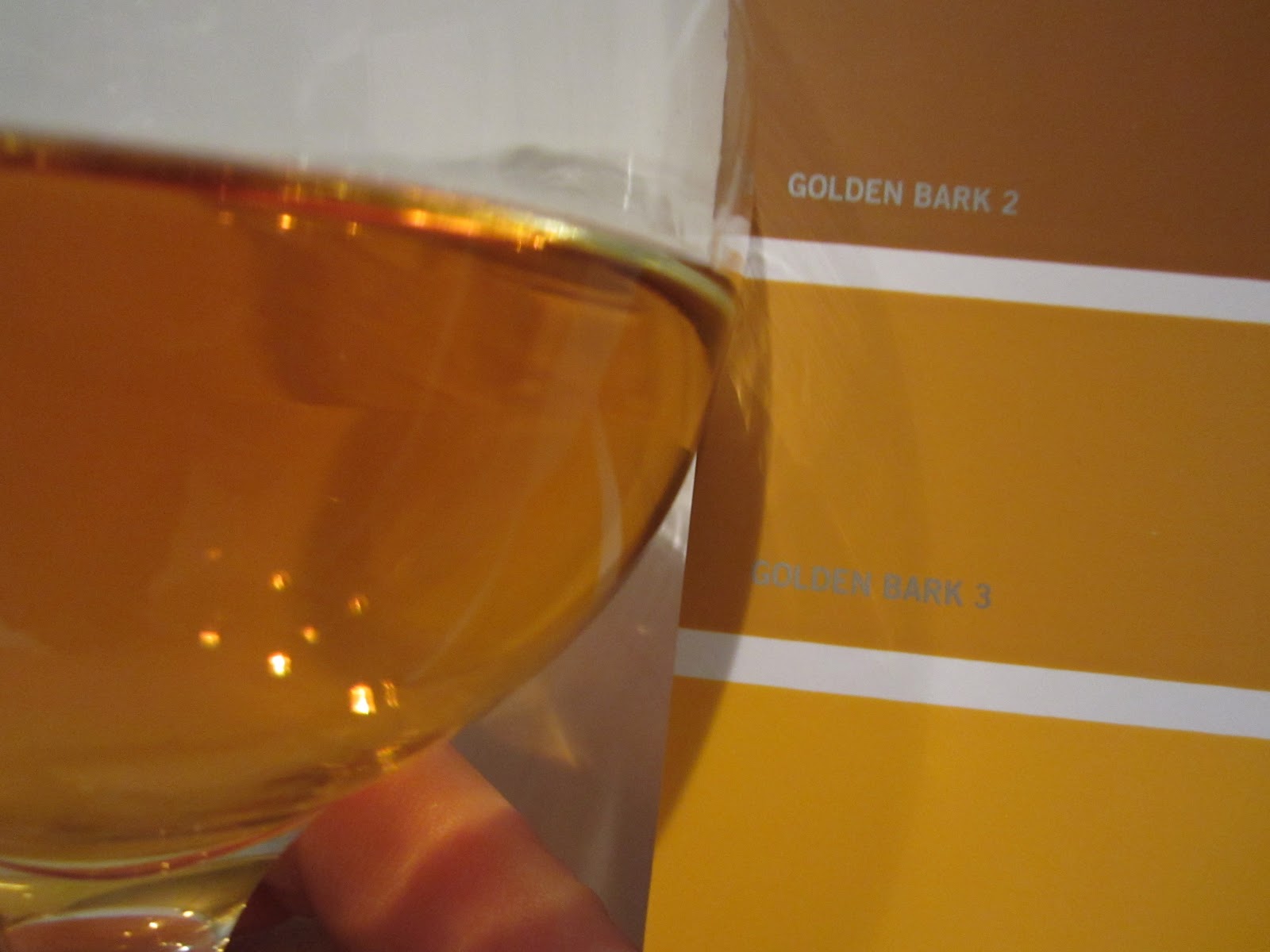
Dewar's 12 yo, golden bark 3
I was initially a little sceptical that I would find any exact match, but I think I did fairly well. I may not be quite on the money, but I think its close enough. Take a look at the picture, and see for yourself. So Dewar’s 12 Years Old, Double Aged is Golden Bark 3. I can’t compare this one to the Dewar’s in the book, because I got the wrong Dewar’s. The one in the book is “Special Reserve”. Oh well.

While I’m on it, I may as well give you a brief first impression of the Double Aged Dewar’s; I was impressed at first. You know that I don’t know how to describe flavours, but my first reaction was, “oh yes, that’s a classy taste”, but then the familiar blended scotch taste took over (must be the grain), and each succeeding sip was an attempt to repeat the experience of the first sip – mostly unsuccessfully. It seems I had become desensitised to it already. If that’s the way it stays, it looks like being a frustrating whisky. Time will tell. And then it will probably tell all over again. Litre frickin’ bottle, I don’t know.
Grant's, sulphur springs 3


I moved on, and was able to try a swatch test with my bottle of Grants’ just before I finished it. It’s a good deal lighter in colour than the Dewar’s, and came out as Sulphur Springs 3, as you can see. At that point I decided I’d try a few more before publishing my findings. Here they are in order of experiment:


Courvoisier VSOP

I couldn’t find a match for this one, but that’s ok as I didn’t get brandy coloured colour swatches. I thought I might find a match though, as in the bottle it looks a lot like whisky. In the glass it actually has a much more red tint than the whiskies I’ve tried so far.

Maker’s Mark

Maker's Mark - no match
No match this time, either. Ian Buxton describes it as amber, but I’m afraid I couldn’t get anything even near to it from Dulux. Interestingly, the St Remy XO brandy that Brenda brought me back from Paris is described on the St Remy website as amber in colour, and Caol Ila is described as amber in the example at the beginning of this post, yet there is a world of difference between these three.

The Black Grouse

This time I had another success, and with another blended scotch. The Black Grouse came out as Earth Glaze 3. It’s always ‘3’ it seems, so far. I don’t know what an earth glaze is – I would have expected that to be more of a brown, but there you go.

Black Grouse - Earth Glaze 3
Finally, the testing has proved to be quite fun, so I’ll keep it up for as long as it continues to be so. I’m not sure yet whether that will mean another specific post, or whether I’ll just throw a result into any article where I happen to mention a new whisky. So we’ll see.

Mrs Cake thinks I’m doing this just to facilitate my growing obsession with whisky, but I continue to protest that I’m just being silly, and that it is entirely for fun. Which it is really. Anyway, it’s her fault: she bought me the 101 Whiskies book in the first place.

That's it from me for this week, then. I expect I'll be back next Friday with something else. Have a great weekend, and here's hoping for some fun alcohol fueled adventures to write about in the near future.