Following on from
last week’s visit to Berlin and Amsterdam, here’s part two, focussing this time
on spirits…
Amsterdam
Jenever (pronounced
“Geneva”, like the Swiss city) is the original juniper flavoured spirit that,
one way or another, evolved into what we know today as gin. I can’t really
remember how I found out about it now, but what started out as a vague plan to
pick some up turned into an intention to incorporate jenever into the trip as,
a few days prior to departure, an episode of Coach Trip involved a visit to a distillery in Rotterdam. You’ll
know if you’ve visited these pages before that I’m not a massive fan of gin,
but spirits are spirits and booze tourism is booze tourism so it would be rude
not to delve.
Our Top Ten guide book was good enough to
include an entry on Wynand-Fockink: a
distillery in the heart of Amsterdam that incorporates a bar and a shop, but
only does tours on Saturday afternoons which was when we flew in.
 |
| Bols Zeer Oude |
Before getting
chance to visit the WF shop, I picked up
Bols
Zeer Oude Genever in a liquor store close to our hotel for 11 euros 50 (you
can pick up a litre of it at
Master of Malt for just over £30). I’m not
sure why some of these products are spelled with a G and some with a J, but I
don’t think we can question Bols here since they are the oldest distillery
brand in the world, and produced the first genever . It’s hard to say whether
that is this one since, apparently Bols began distilling genever in 1664, but
introduced a new recipe in 1820 which is considered the authentic flavour of genever. I don’t know, sometimes I can’t make head or tail of all this stuff I find on the internet. Maybe if I read everything properly instead of doing that
F-reading thing that everyone does on the internet, and means that none of you will actually
read this post… I’m going to have to start planning strategically around that
one day.
There were other
brands available, but they were generally 35% ABV or even less, so I selected the
strongest examples available – or so I thought, the internet says this is
35%... I had thought it was more, but can’t prove that just now. There are
versions from the 70s and 80s at 39% and 37.5%, but I doubt mine was one of
those.
Contained in a clay
bottle, Bols Zeer Oude is apparently best drunk refrigerated, but the fridge in
our hotel room was very small and already had to contain 6 cans of Grolsch and
2 desserts. The Bols never made it into the fridge before it had been consumed.
I enjoyed drinking
the jenever before going out in the evenings, but I didn’t notice the gin-like
element until it was pointed out to me. This element that I consider to stand
out in the flavour of gin – which I assume must be the juniper - is more mellow
and muted in the Bols – making it easier for me to appreciate.
 |
| Wynand-Fockink Rogge |
Here is some more
detailed information about
Bols that you might find interesting.
When we did make it
to the Wynand-Fockink shop one afternoon, I was able to try a few of the
varieties – one that was aged for three years and is said to be close to
bourbon in character and a couple of others I forget now – but the one I chose
to take home was Rogge, which means
rye. I’ve since learned online that they do a cask strength version. If I’d
been informed of that at the time, that would certainly have been the one I
would have gone for. 50cl of the standard variety cost somewhere around 18
euros. Read a little more about the Wynand-Fockink Rogge at some undetermined
time in the future (in a month or two, probably).
Berlin
The experience of my
last booze tourism adventure (Orlando), in which I’d relied on chance to find
liquor stores had convinced me that a bit of research would be necessary on
arrival in Berlin. We passed a couple of stores that looked like they held
potential early on in the trip, but on close inspection, they just turned out
to be newsagents with large and visible selections of beer and wine – so not
necessarily the kind of place you want to focus your spirit purchasing energies
on. I did a little online searching then, and found
this site,
which lists all the notable stores in the Berlin area – and it turned out that
one was just down the street from our Schoneberg apartment.


First though, I
scheduled a visit to
Absinth Depot.
Actually, that’s not strictly true. I
first
scheduled a visit to
Whatever
Spirituosen, which is on Torstrasse in central Berlin and is supposed to be
open from 1pm to 1am if a standard listing on Google is to be believed, but
that certainly didn’t turn out to be the case when we visited. Absinth Depot is
a short walk from there though, so that’s where we went next.
It’s good to have a
bit of knowledge about products before you walk into a store like this because
then you can immediately convince the proprietor you’re not an idiot – which
they seem to respect. Here’s another
idiot to treat with disdain, can quickly change to this person actually wants to spend some money. I was able to give
some specific characteristics that I was looking for, and a few samples were
quickly produced. Brenda commented on the cloudiness, and that gave me the
opportunity to show that I knew that that was known as the louche.
These shops seem to
be set up to give recommendations – you can’t really see exactly what’s behind
the counter, and a few samples are available already, so it makes me wonder –
presumably there’s a lot of stuff he doesn’t recommend so, is there some stuff
he doesn’t sell any of? Is there some stuff he deliberately doesn’t stock?
Because if you’re not going to recommend it, you’re probably not going to sell
it unless it has a reliable market share in spite of your own feelings about
it.
After debating
whether 45 euro was a reasonable amount to spend on a litre of absinthe that I
was buying purely to dole out at parties, I selected
Maldoror on taste, though all three I tried were pleasant with
water, which was a surprise following the
glass
in a glass experiment I’d tried with my
Grande Absenta. I won’t be able to comment definitively until
I’ve delved a little into the bottle however.
Maldoror is a German
product, but the very first example of a blended absinthe – blended from a
Czech, a French and a Swiss absinthe. Colouration is natural, and it is recommended
to be consumed with a little sugar and 2-5 measures of ice water.
It is rumoured among
online
absinthe aficionados that the Czech contingent is
Bairnsfather, which is very bitter and for
this reason, it should maybe be tried with ice.
A discussion online suggested
that, in spite of its winning an award, the finish is overly bitter, though in my limited experience, all absinthe has a
certain bitterness. It was suggested that this appears on the finish, so
potentially after judges opinions had
been decided. Nevertheless, I tried it in the shop and wasn’t complaining of
any bitterness later that afternoon.
Before heading to the local special liquor store we made a
final stop at the nearby Kaisers Supermarket to pick up treats for colleagues
at work, where I found Grappa Paganini for a too good to refuse 5 euros. I’d
never seen nor heard of it before, but my predilection for grappa wasn’t going
to allow me to pass this one by. I actually found it later online and then in a
Sainsburys store (Urmston, I believe) at £14.50. The only other thing I’ve been
able to find out about it online was that someone had bought it purely to turn
the bottle into a bong. You can see why, though they hadn’t commented on the
product itself at that point.
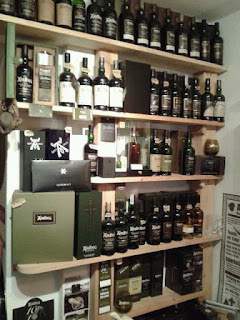 |
| Ardbeg wall |
Given my earlier
purchases that day, by the time we arrived at
Finest Whisky I’d resolved not to spend too much, having already massively
overspent on the absinthe, but I did still need to pick up something distinctly
german. It was almost a shame really because Finest Whisky really is a collection
of some very fine whiskies, that it was a pleasure just to have a look at.
There was even an Ardbeg wall (pictured), which represented the fact that the
store had just been selected as the official Ardbeg supplier in Germany… or
Berlin… or something. I forget, but it was impressive nonetheless.
I’d tried a few
varieties of schnaps during the trip – none of which were anything like the
peach Archers that everyone is no doubt familiar with – and thought
something like that might end up being the way to go. But no, the proprietor directed
me towards korn, which is like german
vodka. I had tried a few as a chaser to my beers in the last few days, but I’d
never heard of it before and didn’t really know what it was.

What I was directed
to then was
Berliner Brandstifter,
which translates as
arsonist. In
general, korn is supposed to be less vigorously filtered than vodka, but this
one has been filtered
seven times,
leading to the claim that it reduces (or even fully eradicates) the possibility
of a hangover. I doubt I’ll ever get to substantiate that claim, but
nevertheless there was enough about it to make me want to take it home.
Only 1000 bottles
are produced each year and all bottles are hand filled and hand-numbered. It
clinked with the grappa when we put it in our bag leading to a slightly awkward
moment when it looked like we might’ve helped ourselves to something else from
the shelves while the guy wasn’t looking, but we hadn’t. It had been a pleasant
visit in all, and Finest Whisky is a shop I’d warmly recommend you visit if you
happen to be visiting Berlin.
Duty Free
I turned down the
opportunities to make purchases at either Manchester or Amsterdam’s Schiphol
airports because, in the first instance I figured I pick something up for
consumption during the holiday in the city of Amsterdam itself, and in the
second because there just wasn’t anything that made my wishlist – though I was
tempted to get some 60% dark rum, before ultimately deciding that was out of scope this time around.

In Berlin though,
and despite pretty much feeling my booze budget had been [over]spent by that
point (one bottle consumed, four further bottles collected), one of my targets
had always been a German brandy, so at less that 10E for 50cl, I couldn’t
really turn down the chance of one last purchase. And this is it,
Asbach Urbrand. The fact it reaches a
full 40% in strength also worked in its favour. I’ve since learned that it
proved to be popular with British troops stationed in Germany, and who am I to
argue with a recommendation of that kind?
Conclusion
I’ve had to ban
myself from buying anymore spirits for the next 2 months as a result of this
little adventure, but that’s ok because I currently have 8 unopened bottles and
I think that’s enough anticipation to hold in reserve for the timebeing. The
only question now is what will I open next? Who’d’ve thought German booze could
be so interesting? I certainly never did.
Post-trip
I have since found
that there are even brands of German whisky. I’m quite glad not to have known
that at the time, as it means there would have been other spirit types I was
inspired to try, but it’s certainly one to bear in mind for the next time, and
we had such a nice time that I wouldn’t hesitate to visit again.
So thanks for
sticking with me through this mammoth travelogue. I’ll be dipping into those
various bottles in the coming months and the results will be vomited all over
these pages, so check back if you’re interested.


